
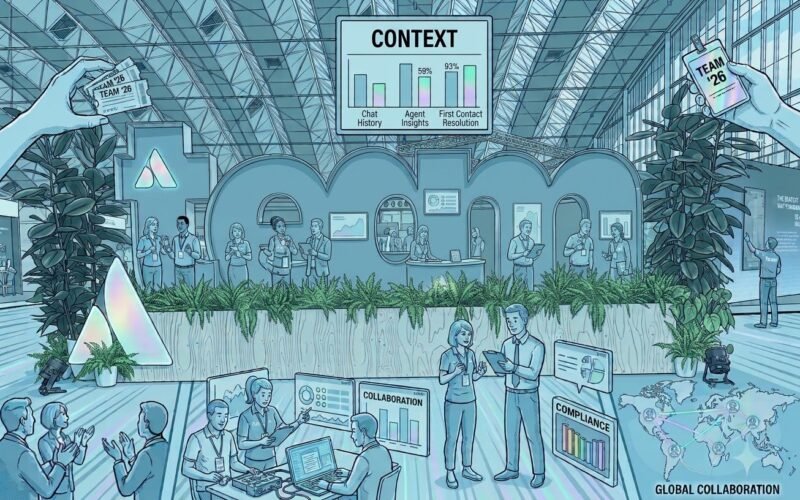
In early October, Atlassian users from across Europe gathered in Amsterdam. There were three days at the RAI, a Sunday unconference at Harley’s House, a partner day, and a Champions workshop with Atlassian product leaders. If you missed it or want to organize your thoughts, here’s my quick summary.
A brief notice: not everything shown on stage is available right away. I’ll note the status for each announcement: GA (available now), Open Beta, Early Access (for selected customers or sign-up), or Coming soon.
The big idea: the end of single-player AI
Right now, most of us use AI by ourselves—one person, one chat window, copying and pasting. Atlassian’s message in Amsterdam was clear: single-player AI is over. Agents should work with teams, not replace them. You can assign them a Jira task, mention them in a Confluence-based comment, or brief them with a Loom video, and then a human reviews the results.
A few numbers from the keynote that show how fast this is moving:
- More than 250 billion objects and relationships in the Teamwork Graph, up from around 150 billion six months ago
- More than 15 million MCP tool calls per day
- 77% of Atlassian’s own pull requests last month were created entirely by agents
The keynote focused on three questions that customers often ask. I’ll use the identical structure here.
1. Which model should we bet on?
Atlassian’s answer: the frontier keeps changing. Bet on your CONTEXT.
Models improve every week, and you can rent them by the token. But you can’t rent the knowledge of how your company works. Models are the engine, and context is the fuel.
Context announcements
- Teamwork Graph: 20+ new connectors (including Zoom and Gong) and a new data context with sources such as Snowflake, Databricks, and Tableau. If you build on Forge, you can use the Teamwork Graph API in your own apps and agents.
- Source Code Context: semantic understanding of your code across GitHub and Bitbucket, plus a new Code Search app. Rolling out.
- Rovo Work: a new reasoning mode with its own cloud computer for long, multi-step tasks such as prototypes and deep research. Early Access.
- Artifacts app: a permanent, permission-aware home for everything you create with any AI tool, indexed into the Teamwork Graph. Open Beta.
- Insights: the successor of Atlassian Analytics. Ask questions in plain language across 20+ data sources, for all paid plans. Rolling out in phases.
- Rovo Desktop and Mobile: native apps that bring your context into any app, one shortcut away. Mobile available, Desktop rolling out.
More in the Teamwork Collection announcement.
2. Will agents replace people?
Atlassian’s answer: agents join teams; they do not replace them. Build human and AI COLLABORATION.
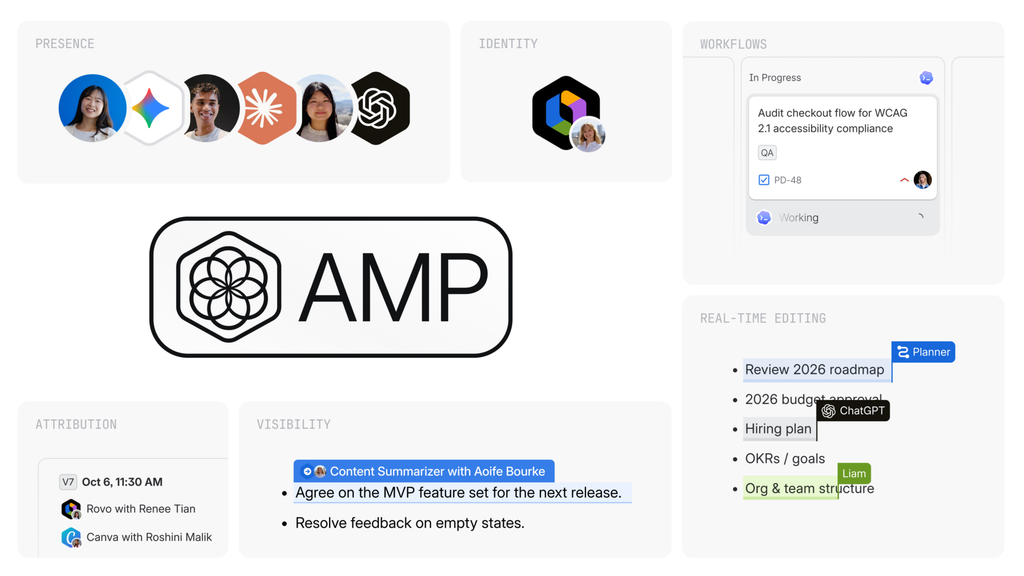
This is where AMP, the Agentic Multiplayer Protocol, comes in. You can think of it as the house rules for your new AI colleagues. The AMP page says it works on three layers:
- Real-time and a sync collaboration: agents work where people already work, in Loom, Confluence, Jira, or through MCP in other tools.
- Identity and shared presence: every agent has its own identity, visible presence and attribution, so you can see which agents are active and what they did.
- Context and governance: the Teamwork Graph provides context with scoped permissions, governed by Atlassian Guard, data policies, admin controls, and audit logs.
Agents can act with a person’s permissions or through a dedicated agent account. Atlassian has also published design patterns for agent experiences, which are worth checking out if you build your own agents. For the best overview, see the platform post: The Atlassian platform is for multiplayer human-agent work.
Collaboration announcements
- Atlassian MCP server: rebuilt with 220 tools, extensible, governed by Atlassian Guard and, according to Atlassian’s internal benchmark, using up to 25% fewer tokens. GA.
- Loom for Mac with Record for Agent: talk, point, and select on screen, and Loom turns it into a detailed prompt for an agent. This is in open Beta. AI overlays to polish your videos are coming soon.
- Planner: people and agents co-author plans in real time and turn them into a Jira backlog. Early Access.
- Agents in Jira, Confluence and Jira Service Management: assign work to Atlassian agents, your own agents from Rovo Studio or third-party agents, or trigger them via automation. GA.
The software side is covered in Atlassian brings the AI-native SDLC from playbook to production.
3. How do we keep up?
Atlassian’s answer: there’s no single solution. Building a nervous system for your organization gives you confidence.
Confidence announcements
- Loom PR reviews: AI writes code faster than humans can review it. Every pull request becomes a short video showing what changed, why, and how it was tested. Early Access.
- Agent sessions in Jira: see and unblock every agent, local or cloud, right from your board. Early Access.
- DX agent effectiveness: find out whether your agents use the right model for the job. GA.
- Service Collection: Rovo finds likely root causes for incidents and flags risky changes before you deploy. AI Change Risk Assessment is GA; the Incident Command Center is in Open Beta. Details in Transforming Service Management for the AI Era and the Community roundup.
- Strategy Collection: track AI spend against budget, by model, team and department. Beta.
What matters for us in Europe
For customers in Germany and the rest of Europe, the trust announcements may be the most important ones:
- EU AI Inference: prompts, context and model computation stay within the EU. Early Access with sign-up, not switched on automatically.
- ISO 42001 certification for Rovo compliance with the EU EU AI Act.
- BSI C5 Type 1, with Type 2 expected.
- Atlassian Guard: find, classify and protect sensitive data, including attachments, and control what the MCP server may access. See Atlassian Guard at Team ’26 Europe.
A practical tip from the governance sessions: Rovo is switched on for all users by default. You can restrict it to a pilot group first, define default access for new agents, and limit which AI clients may connect via MCP. All of this is available in Atlassian Administration today.
What this means for your teams
- Context is now the new currency. If your Jira projects are messy or your Confluence spaces are outdated, you’ll get messy AI answers. Cleaning up is now a business case.
- Governance isn’t a brake—it’s a requirement. In regulated industries, governance is what makes adoption possible in the first place.
- Start small. One pilot group, one real use case, and a baseline before you start.
- Keep an eye on costs. Starting 3 December 2026, usage-based pricing will count automation steps and Rovo credits. One poorly built rule can use up much more than your allowance.
- Read the status honestly. Separate GA from Beta and Early Access before you plan.
Dates for your calendar
- 30 September 2026: new Jira dashboard experience and migrations
- 3 December 2026: usage-based pricing starts
- 31 December 2026: Cloud Fortified ends, Atlassian Enterprise Certified replaces it
- 31 January 2027: End of life for Connect app > Check your connects 3rd party app for updates
- 5 April 2027: Opsgenie support ends, time to plan the move to Jira Service Management
- 20 April: Atlassian team ’27 US
- 5 October: Atlassian team ’27 Europe
Watch the sessions yourself.
All sessions are available in the Team ’26 Europe on-demand library (sign-in required). Good starting points:
- Founder keynote: Your business knows better, also on YouTube
- AI and platform: Rovo, Teamwork Graph, Insights, Assets, Trust
- AI SDLC
- Teamwork Collection
- Service Collection
- Strategy Collection
- Insights
- Planner
If you want a compact summary of the keynote from someone who was on stage, read the Team ’26 EU keynote recap by Sherif Mansour.
My takeaway
Atlassian isn’t just selling tools for teams anymore. Now, it’s selling a team where some members are AI. Our job is to get things in order before these new colleagues arrive.
Which of these announcements is most important for your team? I’d love to hear your thoughts.