


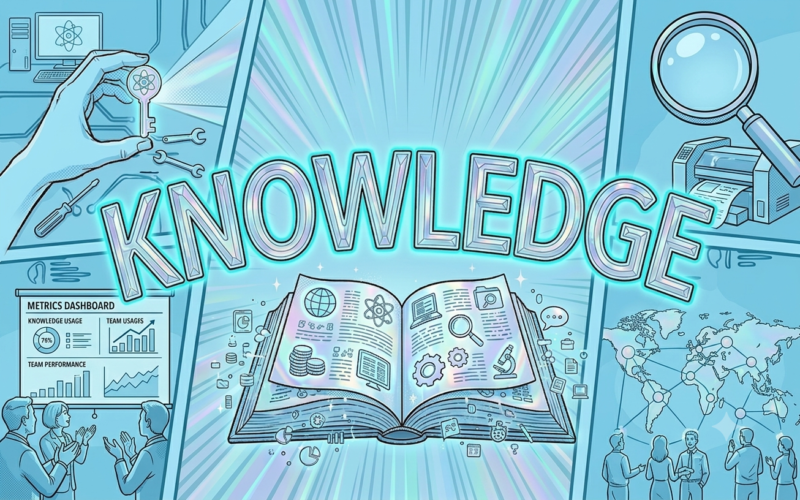
A DJ needs two turntables, a mixer, and a crate of records. That is the entire toolkit, and everyone behind the decks owns roughly the same gear. Yet one set makes a room dance until closing, and another, played on identical equipment, empties it by midnight. The difference was never the hardware. Knowledge: It was reading the room, sequencing the tracks, knowing when to hold a moment and when to break it.
This week I set myself a new goal: sit the KCS v6 Fundamentals exam. I did it because the point is bigger than support alone: in IT support, and increasingly in AI assistants, the missing piece is not a better model or more documentation. It is the discipline that makes knowledge trustworthy. That missing piece has a name, and it existed years before anyone was training a language model. It is called Knowledge-Centered Success, or KCS.
What Knowledge Centered Success actually is
Knowledge-Centered Success (KCS) was developed from 1992 onward by the Consortium for Service Innovation, a non-profit alliance of service organizations, originally known as Solution-Centered Support. It went through several major revisions, arriving at v6 in April 2016, the version that renamed Support to Service to reflect how far the method had spread beyond the classic help desk into the rest of the business.
The core claim is deceptively small: knowledge should be a byproduct of doing the work, not a separate documentation task bolted on afterward. KCS frames it as more of a default reflex than an add-on. Solving problems and capturing knowledge are meant to be the same motion, not two motions performed by two different people at two different times.
The Solve Loop, or knowledge as exhaust
The mechanism that makes this work is called the Solve Loop. A request comes in. The person handling it searches the knowledge base first. If a matching article already exists, they use it, and improve it if reality has drifted slightly from what is written. If nothing exists yet, they solve the problem and write the article simultaneously, as a natural part of closing it out.
Atlassian describes this as five practical steps: capture knowledge from real requests rather than from an internal wishlist, format it using a consistent template, reuse it before ever reaching for a blank page, keep improving what already exists rather than constantly authoring new material, and finally use the accumulated usage data to spot where the actual gaps and opportunities sit. A closely related habit, sometimes called “reuse is review,” holds that every time an article is used to solve something, it also gets quietly reviewed and nudged toward being a little better. Knowledge improves simply by being used, not by being scheduled for review.
Four beliefs holding the whole thing up
Underlying the process are four beliefs often cited in summaries of KCS. Knowledge should exist in abundance, so that most incoming requests connect to something already written rather than to a person’s memory. It should be demand-driven, meaning you write about what people are actually asking, not what you assume they should want to know. It should create value, which rules out documentation written for its own sake and never touched again. And it needs to earn trust, because the moment someone stops believing the knowledge base, they go straight back to asking a human, and the entire point of having one quietly evaporates.
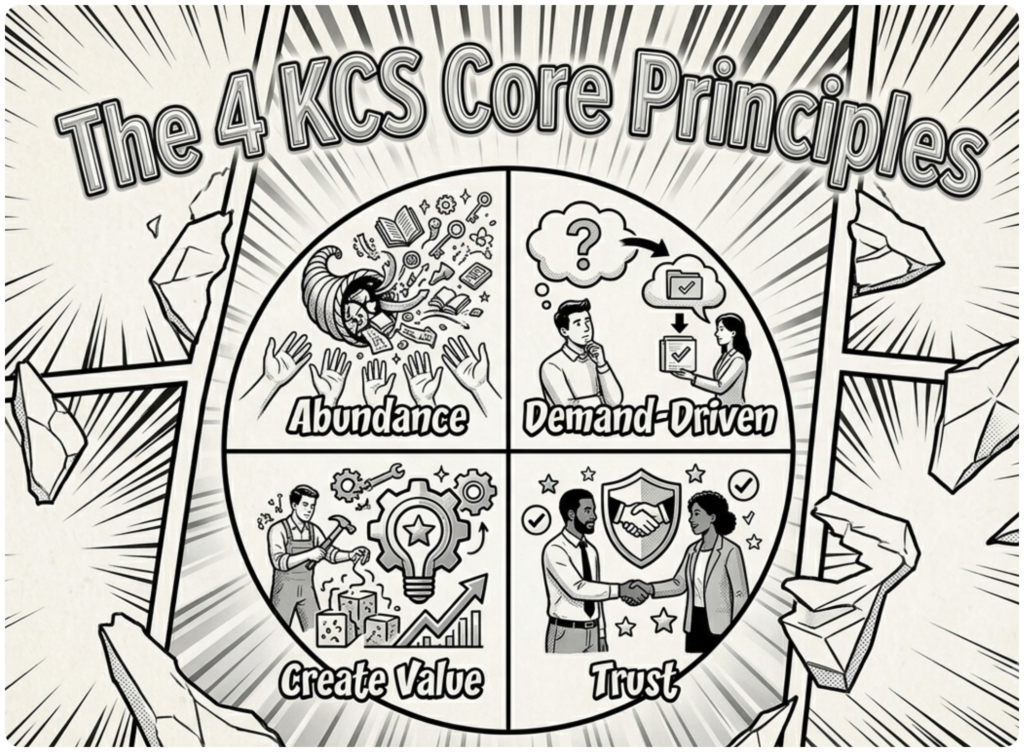
That last belief, trust, is the one that connects directly back to why I think KCS matters far more today than it did when it was purely a support-desk discipline.
Why this stopped being only a support problem
The language around KCS is now shifting further, from Knowledge-Centered Success toward what’s being called Knowledge-Centered Success, explicitly framed around AI readiness. That shift matters because it sharpens the same core point: an AI agent or assistant is only ever as good as the content it is fed. Feed it validated, demand-driven knowledge and it becomes trustworthy. Feed it whatever happened to be lying around, half current, half aspirational, written once and never revisited, and it will confidently hallucinate its way through exactly the same gaps a human would have stumbled over.
Numbers circulating widely in the KCS community indicate that first-contact resolution rates are improving by 30 to 50 percent, analyst ramp-up time is dropping by around 70 percent, and there are measurable gains in both staff employee retention and satisfaction. Separately, benchmarks report that first-resolution times improve by up to 50 percent within the first three to nine months of a full rollout. I would treat all of these as directional rather than gospel, since figures like this always depend heavily on the starting baseline, but the direction is consistent across every independent source I have read, and it lines up with plain intuition: a support organization that already knows what it knows will always out-perform one that has to rediscover it every single time, whether the one doing the rediscovering is a person or a model.
Where ITIL, COBIT, and ISO fit around this
KCS is not the only framework that handles knowledge; it’s just the one built specifically for the point of contact rather than for IT governance in general. ITIL 4 added its own Knowledge Management practice, but it continues at the level of principles rather than a concrete operating loop, so most teams treat it as the larger container within which KCS sits. COBIT treats knowledge as only one of many governance processes, focused more on control and audit than on the daily mechanics of capture and reuse. ISO/IEC 30401 sits closer to ISO 9001: a certifiable management system for knowledge across an entire organization, useful for demonstrating intent at the governance level, but silent on how a single ticket becomes an article. None of them get as specific as KCS does about what happens in the sixty seconds after a problem gets solved.
The obstacle is almost never technical.
Anyone who has tried to introduce KCS runs into the same wall, and it is rarely a tooling problem. A common diagnosis in the KCS community is a fixation on the urgent and the tactical: teams keep closing tickets one at a time instead of investing in the structure that would make the next ticket faster, often because the way people are measured and paid rewards raw resolution speed and says nothing at all about whether any knowledge got left behind.
The reassuring part is that content creation itself is rarely the actual bottleneck. It can be introduced from day one, incrementally, article by article, right inside the ticket that produced it. In Atlassian Jira Service Management, for instance, an agent can create a knowledge article directly from within a support ticket, which makes step one of the Solve Loop close to trivial from a tooling standpoint. The hard part was never the button. The hard part is convincing a team that stopping for ninety seconds to write down what they just learned is not a detour from the job, but the job. (Read more here: https://www.atlassian.com/itsm/knowledge-management/kcs)
The tools were never the hard part.
None of that changes with AI in the loop. Any team can license a model, and most already have some knowledge base sitting around, however dusty. What almost none of them have is the discipline that keeps it current, demand-driven, and trustworthy enough for a person or a machine to reach for with confidence. That discipline is the point of KCS, and it is what KCS has been formalizing since 1992, long before anyone needed it to keep a language model honest. The tools were never the hard part. Reading the room and trusting what is in the crate always was, whether the hand reaching into it belongs to a person or an AI.
References: